![[LOGO]](Logo.png)
I was born in Broxbourne, Herts., in 1944. My earliest known Sampson ancestor began life in the Isle of Ely; him apart, my family roots are predominantly in London, in the (until recently, French-speaking) island of Guernsey, and in the far West Country.
I was educated at Bristol Grammar School and St John’s College, Cambridge University, followed by graduate study at Yale University (USA).
I am a husband, father, and grandfather.
Among my odder claims to fame, I suspect I may be the only computing prof ever to have been the subject of an article in Vogue magazine (the October 2002 issue of British Vogue).
I am a liberal, in the received sense of that term (NB not the recent American sense). That is, I advocate freedom of the individual and oppose over-mighty States and collective institutions. I do not believe that democratic election confers legitimacy on unnecessarily oppressive government. That said, since a society must be governed somehow, I do believe that the parliamentary democracy which we had in Britain in the late-19th and 20th centuries was probably about the least worst way of doing the job. (Anyone who still thinks of Britain as a parliamentary democracy in the 21st century really ought to read Peter Oborne’s Triumph of the Political Class.)
My book An End to Allegiance has received favourable comment as a survey of the “classical liberal” / “libertarian” / “New Right” movement.
In the 1970s and early 1980s I was active in the movement to replace socialist with market principles in British society. By the late 1980s, socialism in the traditional, economic sense had died the death; but it revived in the 1990s in a new, biology-related form as the Political Correctness movement, which I equally oppose.
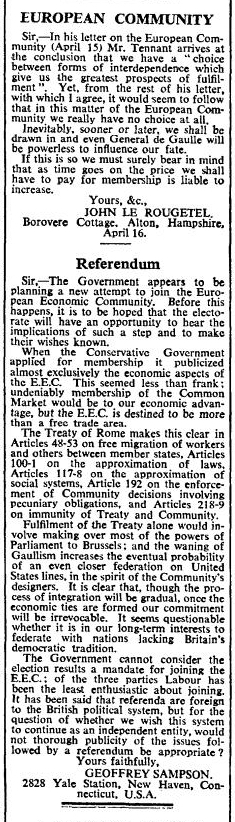
I have been active also in the effort to resist European encroachment on the political independence of the United Kingdom. I believe I was the first person to argue publicly (in a 1966 letter in the Times) that the constitutional implications, if Britain were to join the Common Market (as it then was), were so grave that it ought not to be done without popular agreement through a referendum. (I had taken the trouble to look at the Treaty of Rome, unlike most people in Britain including Members of Parliament and such. At the time, most interested parties really seemed to believe that if we did join, those funny foreign countries would defer to the ideas of their natural superiors.) When I wrote, people laughed … they’re not laughing now.
After thirty-odd years’ active membership of the Conservative Party, I resigned from it when David Cameron became leader, and in 2006 I joined UKIP, the United Kingdom Independence Party. Unfortunately, after ten years when UKIP was a very worthwhile party, and after the supreme achievement of the Brexit referendum result, by late 2016 it seemed to be in a bad way. Before the 2015 election I read the UKIP manifesto carefully, and agreed with everything in it with one very minor exception. But during the approach to the 2017 election it has published “five pledges” to the British people, which include a move to proportional representation. Proportional representation would be good for UKIP but very bad for Britain, so I don’t expect to vote for them again, or renew my membership.
By profession I am an academic. During my career I have migrated in terms of subject area from Oriental languages through linguistics to computing (though certainly not giving up the earlier interests when I moved into new fields), and I have side interests in various aspects of philosophy and political and economic thought.
As a full-time university teacher until 2009 I was teaching E-Business, and IT Law. “E-Business” means electronic business: how information technology is changing the nature of business and trade. The first edition of my book on this topic seemed to be the earliest textbook on e-business to be aimed at computer science students rather than businesspeople. (The most recent edition came out in 2008.) Likewise, my online textbook on Law for Computing Students (originally published 2009 — second edition came out in 2017) seems to have no close competitor to date.
Until I reached what was then compulsory retirement age in 2009 I was Professor of Natural Language Computing, in the School of Informatics at the University of Sussex. (I served for several years as Chairman of that university’s former Computer Science & Artificial Intelligence department.) After retiring from Sussex I spent several years as a research fellow at the University of South Africa. I continue to research and write.
Apart from teaching and a great deal of admin work, and some of the kind of research that one does alone with one’s books in one’s study or a library carrel, much of the work I did during my years as a university prof involved leading small teams of researchers in the execution of computing projects sponsored by the Ministry of Defence and by various national Research Councils. Anyone interested in getting an impression of life in my research team can read a third-party description. The American sociologist Greg Myers used my team for a case study of social relationships in scientific research — his article “Politeness and certainty” appeared in Social Studies of Science, vol. 21, 1991.
In 1998 I took on a role in helping to foster the development of language and speech technology internationally, when I was appointed an Executive Board member of ELSNET, the European Language and Speech “Network of Excellence”. (Changing EU research priorities led to the effective demise of this organization in the mid-noughties.)
Since retiring from teaching, among other things I have been collaborating with an innovative Danish publisher, Ventus. Under the imprint “BookBoon”, Ventus publish textbooks on technical and business topics online, free for readers to download. They generate an income by including in each book a limited number of half-page adverts for things relevant to the book’s readers – mainly graduate recruitment adverts. This seems to be working very well. For instance, my Law for Computing Students textbook mentioned above was downloaded over 130,000 times in 2016. Some downloads will have been done casually by people who don’t end up reading the book, but even a fraction of that figure is massively more than I could ever hope to sell copies of a conventional ink-on-paper book. For authors who aim for a wide readership, this is evidently the way to go!
Some of the thinkers whose writings I have found outstandingly enlightening include the following (in order of birth year) – NB that this certainly does not mean that I see every last thing said by any of these people as necessarily correct or even sensible:
It might seem odd that a list like this made by someone whose central intellectual interest is language should include so many figures associated with the discipline of economics. But I believe that linguists have a lot to learn from (certain strands of) economic thought. Both subjects are fundamentally about human cognition and behaviour, and it is inevitable that economics, with implications for human survival and material welfare, attracts more practitioners than the purely abstract and academic discipline of linguistics. So perhaps it is not surprising if the rare phenomenon of a truly original thinker has a higher probability of emerging in the former than in the latter.
(On one significant link between the two subjects, see an article I wrote in the journal Language in 2014, downloadable here as a .pdf file.)
Less easily explained is the proportion of Central European names on my list. It seems as though there must have been something in the air of the Austro-Hungarian Empire in its dying years which encouraged original thought about human affairs and human nature to flourish. What that something could have been, I have no idea.
As an insurance requirement, another page catalogues my entire library.
My current leisure interests include fellwalking, genealogy, and heraldry – I serve as an adviser on heraldic matters to members of the Arts Society (previously known as NADFAS, the National Association of Decorative and Fine Arts Societies).
last changed 9 Dec 2017
