

![[LOGO]](Logo.png)
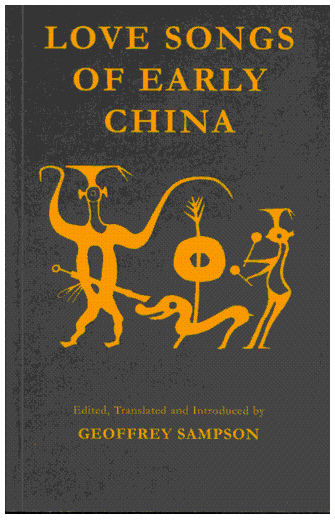
“A time machine that fits in your pocket.” That is the headline of one review of this book. Indeed, the songs or poems collected here are among the earliest literary works to have been written down anywhere in the world. They offer a rare window into the hearts of individuals in a distant country – China – almost three thousand years ago.
Because Old Chinese was an unusually simple language, the window is unusually transparent. The book translates the poems into straightforward English prose, and on facing pages it uses our alphabet to show them as they sounded in Old Chinese. Anyone who cares to read the poems aloud can hear the rhymes and rhythms heard by the original poets; it is easy to look up the words of the short lines in the glossary provided and see how the lines mean what the English says they mean. This is one of the few cases – perhaps the only case – where we can readily understand men and women speaking to us, in their own voices, across millennia.
The book contains 58 of the pieces found in a Chinese anthology whose title is commonly translated as The Book of Odes. The pieces chosen are linked by the theme of love.
The Book of Odes has been famous throughout Chinese history. But language changes down the ages have muffled its sound-music, destroying rhymes and eliminating onomatopoeia. And commentators interpreting the anthology in terms of the far more sophisticated culture of later Chinese history have sometimes obscured rather than clarified the original meaning. This book cuts away those complexities for Western readers. It displays the songs as their first hearers heard them and understood them.
The physical circumstances of the poets’ lives were utterly different from ours: the book’s Introduction sets the poems in their physical and historical background. The various aspects of love, on the other hand, are universal.
Unusually for such ancient literature, more than half of
these poems are written from the woman’s standpoint.
As a sample, though, here is one by a man:
|
|
The Red Pipe |
|---|---|
| Dzenk nrah gu tho, | That demure girl, how sweet she is; |
| zhuh ngáyh a deng ngo. | she was going to wait for me by the corner of the town wall. |
| Uts nu pu kéns, | I love her but I don’t see her, |
|
sóu lhouh dre-dro. |
I scratch my head and pace back and forth. |
| Dzenk nrah gu bront, | That demure girl, how beautiful she is; |
| lu ngáyh lóung kónt. | she gave me a red pipe. |
| Lóung kónt wuh wuyh, | Red pipe, you are really bright, |
|
lot lak na mruyh. |
and I delight in your loveliness. |
| Dzus muk kwuy lúy, | You have come to me like a tendril from the field, |
| whín mruyh tsah luks. | and you are really lovely and unusual; |
| Puyh na tu ways mruyh, | but it isn’t because you are lovely – |
| mruyh nin tu lu. | it is because a lovely girl gave you to me. |
(The “pipe” was probably a flute.)
Some critical comment:
- This book offers a window onto another world. The poetry of archaic China is worth reading for its human interest alone. With his usual erudition and wit, Geoffrey Sampson illuminates the linguistic and cultural–historical aspects as well. “Love Songs of Early China” subtly confronts us with one of the age-old questions: human nature is pretty much the same everywhere—or is it? Read and decide.
- — “Columbus”, in Amazon reader reviews
- … does bring something new to the reading of these poems … To the extent that the reader will gain a better feel for the poems through these reconstructions, I think it is a fine contribution.
- — Edward Shaughnessy (University of Chicago), in Modern Philology
- An interesting reference and interpretation of some very, very old poetry. The introduction is thoughtful and fleshed-out, and the poems themselves have a clear sense of timelessness.
- — Paul Davies, on Goodreads
After 3,000 years the Shijing is at last readable in English. This is the only readable translation I have found, certainly the only one that makes these ancient poems enjoyable to read. … this is a major work of translation of ancient Chinese and deserves far more attention than it has received. I recommend it highly.- — Fu Xi, in Amazon reader reviews
vi + 176 pp.
ISBN 1 900289 75 X
Published by Shaun Tyas, 2006, and available from the relevant Amazon.co.uk page.
However, after this little book was well received, I went on in 2020 to publish a translation in the same style of the entire Book of Odes, all 305 poems rather than just the 58 short poems included in the 2006 book, and with fuller background information on the society from which the poems emerged. The new book gives you everything contained in the book described above, plus a great deal more. If you are interested, please see my web page for the new book, Voices from Early China. (That page gives a code offering a substantial discount on the list price if you buy directly from the publisher.)
last changed 6 Jun 2024